Training Contents:
Apparel Merchandising Terminology (terms and definitions)
50 Most Useful Terms
Used in Apparel Merchandising
Garments merchandisers use various types of terms
and definition in their merchandising life. So, Terminology is very important
for an apparel merchandiser. Garments terminology not only use merchandisers
but also frequently asked in job interview, comprehensive viva and admission
tests. In this article I have given most useful and frequently used garments
merchandising terms.
Most Useful Garments
Merchandising Terminology:
1. Airway Bill: Airway Bill is an
export document. It carries agreement between
exporter and air carrier which is obtained from the airline used to ship the
goods. It’s a receipt of goods received given by airlines. It covers transport
of cargo from airport to airport.
2. Allowance: Additional measurement which added with body measurement
in case of garments making. For example, if the actual body measurement is
80cm, then it’s counted as 84cm during pattern making. Here allowance is 4cm.
3. Applique: Additional fabric added in the face side of the garments
for increasing the beauty of the dress which is called applique. This is a
popular way of decorating fabrics. The appliqué “look” is very popular with
sports and school designs. The process can be used to add “tackle twill”
letters, numbers and designs to garments.
4. AQL: AQL is related to the quality of products. In
textile and apparel industry Acceptance Quality Level is shortly denoted by
AQL. AQL is designed as the maximum average defective items in a lot. It is
expressed in a percentage number of average defective items
5. Back to back L/C: Back to Back L/C is issued on the strength of
master L/C. If the raw materials are imported from a foreign country and the
produced goods by using those raw materials are again exported to that country,
then the L/C opened for that business is called back to back L/C.
6. Basic Block: The pattern which is made is accordance with the area of
different parts of the human body and their flexes and folds without allowance
and style.
7. Bill of Lading: It is a document which provides the terms of the
contract between the exporter and the logistic company to move fright between
stated points at a specified charge. With the help of this document on receipt
from the exporter that the importer takes possession of the goods from the
carrying vessel at the port of destination.
8. Buying Office: It is an independent or store owned office which is
located at a market center and buys for one chain or for many stores. Buying
office is also known as buying house. Buying house is the working as a bridge
between buyer and supplier.
9. C&F: C&F means “Cost and Freight”. It is a pricing system. If
the actual cost of goods and transportation costs are mentioned in the bill,
then the system is called C & F price system.
10. CIF: CIF means “Cost, Insurance and Freight”. It is also a pricing
system. If the actual price of goods, transportation cost and insurance cost
are mentioned in the invoice, then this system is termed as CIF price system.
11. CIFC Order: At this type of order, the seller includes the cost of
insurance, freight and commission for local buying house.
12. CM: The full meaning of CM is Cost of Making. CM is related to the
commercial parts of garments merchandising. That cost may include with
trimmings, Cutting, making, trimmings cost, cost of making time etc.
13. CMP Order: In such type of order the buyer fixes the rate of CMT
with the factory. So the seller does not add the price of fabric with his
costing, but at L/C buyer gives all money to the factory. The factory collects
only CMT money from the bank. Balance money return to the fabric supplier.
14. CMT: It is an abbreviation the amplification of which stands as Cut
make Trim. In this case, garments manufacturer quotes the buyer a proposed
price which covers making cost, trimmings and accessories cost of a garment.
Here, all the other required materials sent by the buyer to the manufacturer.
15. Color Bleeding: Color bleeding occurs when clothing manufacturers
rely on ineffective dying techniques or cheap dyes. Pigment dye come out from
one place to another and is stuck place nearby suck characteristics is called
color bleeding.
16. Compliance: Compliance means conformity of certain standard. The
main aim of compliance is to ensuring the all labor rights and facilities
according to the Buyer code of conduct.
17. Counter sample: The manufacturers produce several numbers of samples
following the approved sample which is known as counter samples. They facility
the bulk production or hung on production floor.
18. CPM: CPM stands for Cost per Minute. CPM can help to find out per
hour, shift, day and week cost of garments.
19. Customer: Importer is known as customer or end buyer. Sometimes they
place order directly to the foreign company or by their satellite office or by
the buying house. Customer or end buyer may be whole seller or retailer.
20. Dummy: It is an exact replicated mode of human body shape which is
stays erected on a stand. It is often used in checking the fitting of an
apparel.
21. Exporter: Exporters are those who sell or export the product to the
buyer of foreign country are called exporter.
22. F.C.L: It is abbreviated with Full Container Load. This is the good
sign of both buyer and manufacturer. Normally this part handle commercial
department in a garments.
23. FOA: The seller delivers the goods to the air carrier at the airport
of departure. The buyer bears the risk from that moment and payees the air
transport cost. In this case, seller bears the cost of materials and making,
does not include air freight.
24. FOB: FOB abbreviated with “Free On Board”, which is a pricing
system. If the actual price of goods is mentioned in the invoice without any
transportation cost and insurance cost, then this system is called FOB
price-system or costing system.
25. Fully Fashioned Garments Industry: The industry which is manufactured
knitted garments by using yarn as main materials instead of fabric is called
it. Here, the main products are Sweater, Pullover and Cardigan etc.
26. Grading: Grading means the stepwise increase or decrease of a master
pattern piece to create large or small size. The process of making a sample
size pattern larger or smaller to make up a complete size range. Grading alters
the overall size of a design but not its general shape and appearance.
27. Grain line: It is the line, which is marked on the patterns of a
garment and the line indicates the warp yarn, as a result, when the pattern is
placed in the marking paper then the Grain line follow the warp yarn of
fabric.
28. Gross Margin: Gross margin is related to calculation of
manufacturing cost. Gross margin is a company's total sales revenue minus
its cost of goods sold (COGS), divided by total sales revenue, expressed as a percentage.
The difference in dollars between net sales and the net costs of merchandise
during a given period.
29. Importers: Importers are those who buy or import the product from
foreign or overseas country in large quantities are called importers.
30. Interfacing: The extra layer of cloth which is used in between the
part of an apparel and facing to increase shape durability and strength of the
apparel.
31. Interlining: A layer of fabric which is used between two layer of
fabric to give the particular area desired shape, durability and to enhance the
strength of that particular position which is called interlining. e.g. collar,
cuff.
32. Invoice: It is a very important document in readymade garment
business which is sent with the goods to the buyer. The invoice includes
products descriptions, prices, number of cartons, number of products in every
cartoon etc. Every item is prohibited without commercial invoice.
33. L.C.L: L.C.L stands for Less Container Load. When small amount of
order execution then less container load for export or import from
manufacturer.
34. L/C: L/C means letter for credit. L/C is an important document on
export, import business. It is also one of the most used words in garment
merchandising sector. L/C is a document issued by a financial institution, or a
similar party, assuring payment to a seller of goods and/or services provided
certain documents have been presented to the bank.
35. Lab-dip: A lab dip is a swatch of fabric test dyed to hit a color
standard. It is a process by which buyer’s supplied swatch is matched with the
varying dyes percentage in the laboratory with or without help of
spectrophotometer. Lab dip plays an important role in shade matching & this
is an important task before bulk production.
36. Lay: Cloth is laid on in more than one layer in accordance with the
length and spread as marker by the marker as preparatory to cutting cloth and
cloth.
37. Line Balancing: Line balancing is a plan of balancing the production
schedule as per the time and action calendar. It levels the workload across all
processes in a cell or value stream to remove bottlenecks and excess capacity.
Line balancing is also applied in garments sewing floor for smooth order
execution.
38. Marker: Marker is a thin paper which contains all the necessary
pattern pieces for all sizes for a particular style of garments. It is made
just before cutting and its main purpose is to minimize the wastages. Marker
width is equal to fabric width and obviously it should not be greater than the
width of the fabric.
39. Needle Gauge: In some sewing machines more than one needle is used.
The gap side long between the two middle.
40. Pantone: Pantone is an universal shade color shade card. It gets
used in all industries for DTM (dye to match). There are 6 digit numbers for
each color. Pantone depends upon TP (take-pad) and TC (take-card).
41. Partial Shipment: If the production is only half done and buyer gave
permission to ship the first half goods then ship the first half goods and then
remaining this shipment is known as partial shipment. It is also known as
prance shipment.
42. Pattern: A pattern is the actual copy of different parts of a
garment that is made by cutting board paper after sketching on it. Pattern is
also use as guide of a marker paper.
43. PPM: PPM abbreviated is pre-production meeting. This meeting is held
just before going to the bulk production. In this meeting buyer or his agent,
merchandiser, sample manager, all remain present. They decide on how to and
when to start the production. If the decision Okayed, the sample is ready to go
for final production.
44. Pressing: Pressing is a finishing process done by a cloth to heat
and pressure with or without steam to remove creases and to impart a flat
appearance to the cloth or garments. There are various types of pressing which
are applied in garments.
45. Seam Allowance: The margin kept for stitching the garment is known
as seam allowance. Seam allowances can range from 1⁄4 inch (6.4 mm) wide to as
much as several inches.
46. SMV: SMV stands for the Standard Minute Value. It takes a worker to
complete a specific operation or produce a specific garment. SMV is important
topic in garments sewing floor. Standard Minute Value is related with garments
time study.
47. Subcontract Order: It is indirect order, the order is received by
another factory and when it is not possible for that factory to complete the
production within the period of time, in that case they share the order with
other factory by giving subcontract. The subcontract factory only gets the CM
charge by local money from the order taker.
48. TNA: TNA is a proper collaboration of Time and Action. In a Textile
industry, to execute an export order, need to regular evaluation of production
activates with the help of times. This regular evaluation is called Critical
Path Method or Time and action plan. It is also known as issuing plan or
production schedule or time and action plan.
49. Trimmings: Whatever except for the base cloth are used in an apparel
are called trimmings such as button, lining, interlining and thread etc.
50. Vendor: Vendor is very common word in Readymade Garments. In a
normal word we know that vendor is a seller, resource, manufacturer or
supplier.
-Understanding Merchandise, Merchandising, Management, Marketing
for Merchandiser and his/her characteristics
Role of Merchandiser in
Apparel Industry
ROLE OF MERCHANDISER IN GARMENT INDUSTRY
 Prashant G. Khandalkar
DKTE’s Textile & Engg. Institute, Ichalkaranji,
1. INTRODUCTION:
Merchandiser is the BRIDGE between the industry and
the buyer. He have to look after every job like buying the raw material which
is required to finish the product, making the garment, finishing the garment,
documentation, finally shipping. He is the responsible person to make the
product. A garment export unit generally has many department like stores,
cutting, production, packing, checking etc. in which
Merchandising department a linking device of all.
The job of a merchandiser is to co ordinate with the entire department in the
office as well as the customers. The merchandiser is the one who creates a good
relationship in between exporter & buyer.
Merchandising is a specialized management functions
within the fashion industry. It is the business that moves the world fashion
from designers showroom to retail sales floor and in to the hands of consumers.
It is the internal planning that takes place within a retail organization in
order ensures adequate amount of merchandise are on hand to be sold at prices
that the consumers are willing to pay to ensure a profitable operation.
Following are the responsibilities of merchandisers which gives importance
to them;
- Internal
& external communication,
- Sampling,
- Lab dips,
- Accessories & trims,
- Preparing
internal order sheets,
- Preparing
purchase orders,
- Advising
and assisting production,
- Advising
quality department about quality level,
- Mediating
production and quality departments,
- Giving
shipping instructions and following shipping,
- Helping
documentation department,
- Taking
responsibility for inspections and
- Following
shipment.
2. EVALUATION OF MERCHANDISER IN GARMENT:
The concept of term “
Merchandising” can be traced dated back from the
early historic period when the emergence of the trade between the countries.
There are numerous notes about the existence and evolution of trade between the
bigger civilizations in those periods like Greek, Roman, Indian, Chinese, and
Egypt .But during those days the meaning of the term merchandising confined
merely to exchange of materials or commodities which were availed from nature
or produced from nature and they were not manufactured for specific purpose or
specific customers. There was exchange of materials which fulfills the basic
needs of living like commodities, live stocks, textiles and luxurious items
like gold diamonds, precious stones etc…Earlier days the production of goods
was home based and family oriented which were not mass produced. In the
industrial period, home production was replaced by factory system and hand
operations were replaced by machines. Mass productions were followed by
large-scale consumption.
The term “Merchandising” got its significance after the industrial revolution
that emerged during the 20th century after World War 2 and particularly during
the period when there was a dramatic shift from Custom Made Tailoring to Ready
Made Garments. During this period there was great demand for product
development. Merchandising evolved as a bridge between the design and sales to
fill the needs. It got its further momentum when the market concept which give
more impotence to the customer needs, emerged in the industry.
The period between 1960 and the early 2000 saw dramatic changes in the
structure, focus and content of apparel companies particularly in U.S. During
1970’s there was a remarkable growth surge to the apparel industry which
continued trough the 1980 and 1990. United States played a major role in the
evaluation of merchandising in apparel industry.
The necessity of merchandising lies essential due to the following factors:
- Dramatic
growth,
- Complicated
raw material & process,
- Complex
network,
- Advent of
new styles,
- Reduced
Product Life Cycle,
- Textile
innovations,
- Computer
applications,
- Global
transition
To achieve this level of
different control while developing, executing and delivering a product line
that meet the rapidly changing needs of target market, it requires a very
special management professional which considered being a “Merchandising
profession”.
3. TYPES OF MERCHANDISERS:
3.1
FASHION MERCHANDISER:
Fashion merchandising involves all the activities
starting from the fashion forecasting, design and product development till to
retail sales and this also include production merchandising and retail
merchandising. This will be taken care by the buyer’s part. Fashion merchandise
includes items of retail merchandise which have decorative value either with or
without also having functional value. Fashion merchandise includes mostly item
of apparel since they can all be decorative and functional.
Fashion merchandising refers to all the planning and activities involved in
bringing the right fashion merchandising at the right place at the right time
with right quantity at the right price and with right sales promotion. The
fashion apparel world exists between the designer and the retail customer. The
field of fashion merchandising exists to service the designer –customer
relationship.
|
|
|
Fig 2: Process flow
of fashion merchandiser
|
Steps are elaborated as
fallows;
Fashion Forecasting: It shows or direct the company new fashion
presentation for the upcoming season, so that it can understand the new fashion
concept, the store‘s Merchandising approach and better help to their customer.
Generally fashion prediction is done by the fashion direction in case of big
organizations and by owner himself in case of small organizations.
Design development: The design is developed based on themes using the
element s of design such as color, texture, line, shape and fabrication and
adopting the principle of fashion such as proportion, balance, rhythm, emphasis
and harmony. The design development should be practical which suits the current
trends & also feasible to convert into the finished product. Design
development is mainly done on the requirement of number of lines and groups
that are going to be offered by the company for the particular season.
Sample development: The collection of design created by the designers,
the design which are having good potential are selected and taken for sample
development.
Product specification: this information of will be useful in setting the
product specification for the particular garment. A product specification will
guide the production department to develop and plan their merchandising and
production planning and organize the thing for effective and efficient
production of the merchandise.
Merchandising plan or policy: a
fashion merchandising plan or policy is a long
–range standard for fashion buying and selling as well as for related
activities like sales promotion. Merchandising plans are planned several months
before the selling season.
Assortment planning: A merchandise assortment is a collection of various
types, quantities and price of related merchandise usually grouped under one
classification within a department. A good assortment keeping will appeal a
particular group of customers.
Buying: It is a very crucial activity of the fashion merchandising
because this is the actual process of manufacturing the good and bringing them
for the sales at retail stores. A buyer’s responsibilities include both the
buying and selling aspects of retailing.
3.2 APPAREL EXPORT MERCHANDISING:
Apparel export merchandising may
be defined as ‘all the planning & activities involved right from the
buyer communication & order receiving till the execution or shipment
of the order by fulfilling the following factors (Six Rights):
Right Merchandise: Retailers must fill their shelves with the
merchandise that customer wants.
Right Place: The location of the merchandise is of prime importance since
it decides the accessibility. Much merchandise is seasonal in nature and must
be on hand when it is most needed.
Right Time: Much merchandise is seasonal in nature and must be on hand
when it is most needed.
Right Quantity: A profitable balance between volume of sales and amount
of inventory is the desired goal.
Right Price: Merchandiser must arrive at a price that is high enough to
give the store profit and yet low enough to meet the competition and customers
expectations.
Right Promotion: Right balance between the investment and the appeal
created for the customers.
|
|
|
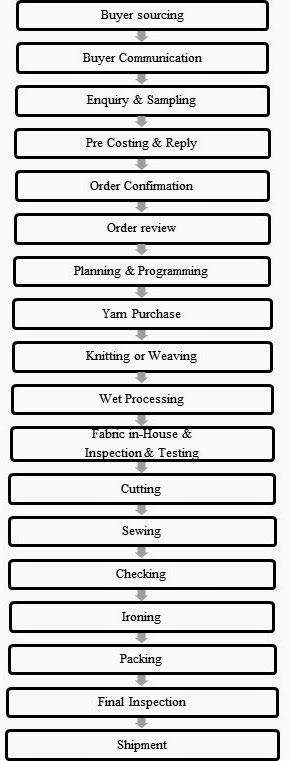
Fig 3: Process flow
in Apparel industries
|
The successful execution of any
garment export order depends on the work performance
of a merchandiser.
Apparel merchandiser is the person who plans and
coordinates all the activities right from the order procuring and till the
shipment order. A merchandiser should have the comprehensive knowledge of his
work procedures and responsibilities so that he could perform his job
efficiently and effectively. In the apparel export industry, a merchandiser has
to perform the following functions;
Communication: It is one of the foremost functions of merchandiser
because the merchandiser has to communicate with different levels of people in
his day to day activities.
Planning & Programming: A merchandiser has to check the order
requirement, planning for the given order, programming for various activities,
proper allocation of work to the assistants.
Follow ups: It includes sending of samples at various stages of order,
buyer and buyer house for sample and other approvals.
Decision making: A merchandiser has to make several decisions during the
order processing like giving approvals like fabrics, color, design,
accessories, and packing, selection of suppliers and vendors, selection of
buyers, sometimes time extensions for order shipment.
Sourcing & Purchasing: A merchandiser may have to do sourcing and
purchasing for raw materials and accessories, suppliers and vendors, new
designs, new buyers.
Controlling: This is the crucial activities for any merchandiser. A
merchandiser has to make sure that all the activities are carried out as per
the planning and even if there is any deviation, he/she should make the
alternatives measures.
Coordination: Merchandiser has to coordinate in such way to reduce the
uncertainties and difficulties and if there is a problem arises, the
merchandiser has to support and lend helping hand in order to complete the task
successfully in the given period. Both the controlling and coordinating
activities complement each other and a merchandiser has to adopt the both
accordingly,
Negotiation: It is the activity of convincing, compromising and
cooperation which would benefit the both parties involved in the
negotiation.
Costing: It is the process of estimating the expenditure of a given
product and the subsequent price. It is another crucial function because mostly
order conformation depends on the price offered to the buyers. The merchandiser
should know the current prices and rates of various products and processes to
do the accurate costing.
Meeting: There are two types of meeting a merchandiser has to be
involved. First type, a merchandiser has to conduct the meeting with the
concern department in charges to discuss about the proceedings and the status
of the running order. In second type, a merchandiser has to attend the meeting
with the superiors or buyers or business people in giving reporting or
participation or discussion.
Forecasting: Forecasting is the activity of predicting the future
happenings or problems. A merchandiser has to predict the future uncertainties
in the current order or industry so that alternative actions or corrective
measures can be taken in advance this also includes giving suggestion or ideas
about new technologies or new products or latest industry trends.
3.3 APPAREL RETAIL MERCHANDISER:
The word ‘Retailer’ is originated
from the French word ‘retailen’ which means ‘to cut again’. Retail business
involves cutting off a smaller part from a big or large good or product and
selling it to the end users. Retail merchandising involves all the activities
related to direct selling of products or services to the ultimate consumers or
users of the product for personal, non-business purpose. Retail merchandiser
sells products in less quantities and they act as an inter mediator between the
ultimate consumers and wholesalers. A retailer is both a marketer and a
customer and he creates place, time and facilities to sell the goods. It is
difficult, time consuming and expensive, hence the retailer takes risks through
ownership.
Functions of a retail merchandiser
- They
provide personal services to all consumers.
- They give
two way information; from producer to consumer and vice versa.
- They
facilitate standardization and grading of goods.
- They
undertake physical movement and storage of goods.
- They
assemble goods from different suppliers and wholesalers.
- They keep
ready stock of goods to supply to consumers.
- They
extend credit facilities to the consumers.
- They
create demand by presenting window display, events etc.
- They also
undertake sales promotional activities.
- They
assume risk by stocking and providing goods to the consumers.
Modern day
retail formats can be classified in to hypermarkets, supermarkets, discount
stores convenience stores, department stores, specialty stores, e-tailing and
malls.
ORGANISATION STRUCTURE OF
A RETAIL ORGANIZATION:
|
|
|
Fig 5 Apparel
Retail Merchandising Process
|
TASKS
OF A RETAIL MERCHANDISER:
1. Analyzing the local customers: Sales in a particular store will be
determined by several factors. A retailer must consider these factors,
- The
geographical location of the store,
- The
population content of the area,
- The social
activities that the area offers,
- The
economical conditions and level of the local population,
- The
fashion influences of the particular population.
2. Selecting a fashion image:
Every retail store has a retail image in the mind of customer irrelevant of the
store want to have it or not. A retail merchandiser should make use of this
fact by creating his own store’s image which would attract the customers. The
type of fashion image they want to have depends on the type of target customer
the store want to attract.
3. Buying the merchandise: Buying fashion merchandise for a retail store
is not an easy job. It requires a lot of planning for budget, selection of
merchandise, selection of supplier’s. Also it is important to decide on the
quality of the goods to be ordered.
4. Receiving and stocking the merchandise: When the ordered goods arrive
at the stores, it should be checked carefully for the quantities against the
shipping invoice or packing list sent by the supplier. The quantity of the
goods received should be checked before they are sent for display or for
selling. After the goods are received and checked, then it should be marked or
tagged and kept in stock for sales.
5. Display: The way in the merchandise is displayed is very important
for sales. Good display always enhances the sales of the store and a poor
display may slow the sale of good merchandise. The store’s image is based on
the principle of use of space for display.
6. Sales promotion: Sales promotion is very much important to the
successful sale of merchandise. Sales promotion refers to promotion of sale of
merchandise, services or ideas. It includes activities like advertising,
publicity, visual displays, fashion shows, special events, personal selling
etc.
7. Sales evaluation: Once the selling season is over, the next thing a
store has to do is evaluate the sales of the season. This include analyzing the
sales by product wise, style wise, size and color wise, unsold items, fast sold
goods, price line wise etc.
VISUAL MERCHANDISER:
Every customer wants to see the
product before they do purchase. A store has to display the products what it
has for sales. And the display should be done in away so that it should attract
the customer.
Visual merchandising is an art of displaying the
things in an attractive way so that it could attract the attention of the
customer and persuade them to buy the product. Visual statements made in the
store windows are the customer’s first view with the store.
Function of a Visual merchandiser as follows;
- Planning a
merchandise themes,
- Making the
seasonal calendar of VM display,
- Selection
of merchandise for display,
- Decisions
on where to display and number of VM displays,
- Arranging
the VM display in concept with the supplier concepts,
- Procuring
and arranging of VM elements,
- Evaluation
of the VM effects foe future planning,
- Comparison
study of VM display of competitors, Forecasting.
MODERN
RETAILING:
The modern retailing in India is at the blooming stage with currently
accounting to 5% in the total retail market in India. Organized retailing is
growing at the rate of 27% and by 2015 it is estimated that organized retailing
would be US$ 110 billion, around 20% of the total retail market. The apparel
and clothing industry being positioned at the first place and also the spending
on apparel and clothing among the customers are getting increased, it is very
important to study the changing behavior of customers.
|
|
|
Fig 6 Retail market
segment in India
|
4. SCOPE OF MERCHANDISER IN FASHION INDUSTRY
4.1. Educational Requirements of
Merchandiser:
A degree in fashion merchandising is usually an intricate blend of Textile,
fashion and business. Many traditional colleges and universities, as well as
art schools, offer targeted textile, fashion merchandising degree programs.
Some individuals may prefer to specialize in specific areas of textile, fashion
merchandising, like marketing or buying, while others may prefer to do it all.
Some retail stores also offer special fashion merchandising training programs
in lieu of a degree.
4.2. Salary Information of Merchandiser:
Salary of local merchandiser is in range of 20,000-40,000 Rs. The average
salary for fashion merchandiser, according to Simplyhired.com, is $47,000.
First-time retail workers make from $7 to $11 an hour. As a person goes on to
become a manager, the salary will increase to about $16 per hour, as of 2009.
Shipping, purchasing and fashion distribution workers will pull in an annual
salary of $25,000 to $60,000. Those working for top-level fashion stores will
take home from $70,000 to $100,000.
4.3. Experience:
Aside from working in clothing retail stores, interested fashion merchandisers
are advised to take college courses to further their eye for fashion and to
combine that aspect with astute business knowledge. People who wish to advance
at a rapid pace should have a good grasp of the fashion as well as business
side of merchandising. Typical classes offered to a potential fashion
merchandiser include the history of fashion, business-oriented courses and
consumer research studies. To obtain an executive position, those interested
will have a much better chance of getting hired with a master's degree in
business combined with a fashion-based curriculum.
5. CONCLUSION:
On this paper we have conclude that the merchandising is a growing up as well
as important department for the garment industry. It has very good scope in
present as well as in future& also has greater opportunities.
6. REFERENCES:
Books:
- FASHION-
from concept to CONSUMER 4TH edition by Gini Steplens Frings
- QUALITY
CHARATURUSATION OF APPAREL by dr. subrata das
- THE
APPAREL INDUSTRY- second edition by Richard M. tones
- FASHION
TECHNOLOGY- today & tomorrow by nirupaman pundir
- FASHION
RETAILING- a multi-channel approach by ellen diamond
WEB PAGES:
- www.fibre2fashion.com
- www.Simplyhired.com
-Knowledge and activities, Sequential functions for a
Merchandiser
Working Procedure of a Garment Merchandiser from Order Receive to Shipment
What is Merchandiser and
Garment Merchandiser?
Merchandiser is a person who
interacts with the buyer and seller, I mean he plays dual role and also puts
efforts into proper relation between buying houses/ buying agents/ agency and
seller/ exporter in terms of executing an order.
A good merchandiser has the attributes of hard work, sincerity, loyalty, team
work, manager, negotiation etc. Customer satisfaction and retention is mainly
depends on a good merchandiser.
|
|
|
Fig: Garment
merchandiser's desk
|
Following definitions
will clear about merchandiser:
Merchandise- means goods bought and sold; and trading of goods.
Merchandising- is an activity of selling and promoting the goods.
Merchandiser- is a person who do all activity of merchandising.
In the above discussion we can learn about a merchandiser. This is a common
discussion of a merchandiser. Because every business has done by a
merchandiser. But our topic is apparel or garment merchandiser. Garment
merchandiser is also like other merchandiser but here they do
garments business. Normally their offices are called
buying house.
Now we will know about merchandiser working process with a chart:
Working Flow Chart of a Garment Merchandiser
Sourcing of buyer (Basically it is a primary and principle work)
↓
Order received from the Buyer with details
↓
Discuss with planning department of factory for knowing availability of
production.
↓
Discuss with prod responsible person like as Director/GM for capability of
handling such order and probable productivity per hr.
↓
Analyze product package and space sheet for costing.
↓
Calculate the consumption of fabric.
↓
Analyze the fabric content, knitting pattern, GSM and do fabric costing.
↓
List out all Accessories, do the consumption and costing.
↓
Analyze printing, embroidery, value addition work washing for costing.
↓
Analyze productivity per hr. with machine and manpower requirement.
↓
Assess cost of making per dozen.
↓
Confirm price from component authority
↓
Sample development
↓
Quote price to buyer
↓
Price negotiation with the Buyer
↓
Confirmation of order and receive the order sheet
↓
Prepare time and action calendar (with available production lead time)
↓
Prepare Gantt chart (In support of T&A and incorporate all important issues
and events with completion date)
↓
Receive size color breakdown and color standard.
↓
Prepare lab dip, strike off, yarn dip etc and arrange approval of the same.
↓
Receive art work and sample for printing, embroidery, value addition work,
washing and get approval for the same.
↓
Develop all samples and submit the same to buyer for necessary approval.
↓
Obtain and ensure all approval as per T&A (time & action) and Gantt
chart to facilities production as per plan.
↓
Receive master L/C (letter of credit)
↓
Prepare final cost approval sheet to facilitate opening of all Back to Back
L/C.
↓
Open BB L/C for yarn, accessories, printing, embroidery etc
↓
Arrange all fabric and accessories and ensure in house of the same as per
T&A.
↓
Source for printing, embroidery, value add work, washing and complete deed of
agreement with them.
↓
Ensure inventory of all items on arrival to store to confirm the qty, color,
sizes and quality as per requirement
↓
Arrange all pre-production meeting and inspection on time.
↓
Arrange all lab test on time.
↓
Ensure dispatch and approval of all samples which may affect the final
inspection and shipment
↓
Collect daily production and quality report
↓
Arrange final inspection on schedule date.
↓
Do load calculation and ensure booking of all load carrying transport well in
advance.
↓
Ensure space booking with sea and air freight forwarder.
↓
Help commercial department to submit all documents to bank on time.
↓
Ensure realization of full payment from bank as per shipped quantity and price.
Note: If occur mistake any process then obviously
comment here. I'm trying to give accurate information.
-Merchandising backbone: Communication,
Negotiation, Market Knowledge
-Merchandising Technical requirements: Fundamentals
on Yarn, Fabric, Processing, Processing, Printing, Embroidery, Washing
Merchandising Heart: Fabric Consumption, Costing
and Offering Prices
Merchandising Microscope: Yarn Count, GSM, Fabric
Construction, Color Panton,
Merchandising Quality tools: Fabric Inspection
methods, Apparel Inspection Method(AQL), Measurement Techniques, Trims Cards
Merchandising Sourcing: Trims and Accessories,
Carton
-Merchandising Planning tools: TNA Plan, Critical
Path Method,
Merchandising Production Control: Sewing Machines
for T-shirt, Polo shirt, Trouser, Woven full sleeve shirt, woven pant
-Preparing packing list, assortment
-Types of Samples and there what parameters must in
each samples
-Merchandising Export tools: Containers and space
calculations, Forwarders, International payment methods and documents for L/C
payment

 Posts
Posts