Sunday, November 27, 2016

Flow Chart of Garments Manufacturing Process

Garments Manufacturing:

A complete garment has to face several processes from its order receiving to shipment. During garments manufacturing, a process flow chart must be needed to complete an order easily. Also a process flow chart helps to understand a garment manufacturing method that how the raw materials are converted into the wearable garments.

Garments Manufacturing Process

Flow Chart of Garments Manufacturing Process / Technology:

A basic garment manufacturing flow chart is presented in the below:
Design

Pattern Making

Fit Sample Making

Production Pattern Making

Grading

Marker Making

Fabric Spreading

Fabric Cutting

Cutting Parts Sorting or Bundling

Sewing

Garments Inspection

Garments Ironing and Finishing

Final Inspection

Garments Packing

Cartooning

Shipment
Each process of garments manufacturing flow chart is discussed in the below with the details:
1. Design:
Design is provided by the buyer. After placing an order buyer send the technical sheet and art-work of an order to the merchandiser. This process is done by both manually or by using computer.
2. Pattern Making:
By following technical sheet and art-work, pattern of each garment style should be made. It’s done by both manually and by using computerized method.
3. Fit Sample Making:
The main target of making a fit sample is to follow the details instruction about that garments style. After making it’s sent to the buyer to rectify. It’s done by manually.
4. Production Pattern Making:
For bulk production, allowance added here with net dimension. Production Pattern Making is done by both manually and by using computer.
5. Grading:
During an order confirmation, the buyer suggests about the size ratio of that order. So that order should be graded according to the buyer’s instruction. Grading is done by manually or by using computer.
6. Marker Making:
Marker is a very thin paper which contains all the parts of a particular garment. To make the cutting process easy, it’s must be needed. Marker making process can be done by both manually and by using computer.
7. Fabric Spreading:
To cut the fabric properly fabric is spread in lay form. Fabric Spreading is done by manually or by using computerized method.
8. Fabric Cutting:
Fabrics have to cut here according to marker of garments. Fabric Cutting process is done by using manual method or computerized method.
9. Cutting Parts Sorting or Bundling:
Here, cutting parts have to sort out or make bundling to send these easily into the next process. This process is done by manually.
10. Sewing:
All the parts of a garment are joined here to make a complete garment. Sewing process is done by manually.
11. Garments Inspection:
After completing sewing, inspection should be done here to make fault free garments. Garments Inspection is done by using manual method.
12. Garments Ironing and Finishing:
Here garments are treated by steam; also required finishing should be completed here. This process is done by using manual method.
13. Final Inspection:
Finally the complete garments are inspected here according to the buyer’s specification. Final Inspection is done by manual method.
14. Garments Packing:
Complete garments are packed here by using buyers instructed poly bag. Garments packing are done by using manual method.
15. Cartooning:
To minimize the damages of garments, all the garments have to cartooned by maintaining buyers instruction. This process is done by manually.
16. Shipment:
After completing all the required processes it’s finally send to the buyer.

Saturday, November 26, 2016

Introduction to Pattern and CAD

The course includes:
  • Computerised pattern development techniques
  • Pattern input via digitising
  • Computerised pattern development techniques
  • Converting traditional grading methods into computerised techniques
  • Lay planning/costing
  • Creating line drawings for range boards and specification sheets.
Pattern:
In sewing and fashion design, a pattern is the template from which the parts of a garment are traced onto fabric before being cut out and assembled. Patterns are usually made of paper, and are sometimes made of sturdier materials like paperboard or cardboard if they need to be more robust to withstand repeated use. The process of making or cutting patterns is sometimes condensed to the one-word Patternmaking but it can also be written pattern making or pattern cutting.
A sloper pattern (home sewing) or block pattern (industrial production) is a custom-fitted, basic pattern from which patterns for many different styles can be developed. The process of changing the size of a finished pattern is called grading.
Several companies specialize in, usually employing at least one specialized patternmaker. In bespoke clothing, slopers and patterns must be developed for each client, while for commercial production, patterns will be made to fit several standard body sizes.

Pattern making:

A patternmaker typically employs one of two methods to create a pattern.
The flat-pattern method is where the entire pattern is drafted on a flat surface from measurements, using rulers, curves and straight-edges. A pattern maker would also use various tools such as a notcher, drill and awl to mark the pattern. Usually, flat patterning begins with the creation of a sloper or block pattern, a simple, fitted garment made to the wearer's measurements. For women, this will usually be a jewel-neck bodice and narrow skirt, and for men an upper sloper and a pants sloper. The final sloper pattern is usually made of cardboard or paperboard, without seam allowances or style details (thicker paper or cardboard allows repeated tracing and pattern development from the original sloper). Once the shape of the sloper has been refined by making a series of mock-up garments called toiles (UK) or muslins (US), the final sloper can be used in turn to create patterns for many styles of garments with varying necklines, sleeves, dart placements, and so on. The flat pattern drafting method is the most commonly used method in menswear; menswear rarely involves draping. There are many pattern making system available, but M. Muller & Sohn (http://germanpatternmaking.com) is widely used for its accuracy and fit for different body figure.
The draping method involves creating a muslin mock-up pattern by pinning fabric directly on a form, then transferring the muslin outline and markings onto a paper pattern or using the muslin as the pattern itself. [1]

Pattern digitizing

After a paper/fabric pattern is completed, very often pattern-makers digitize their patterns for archiving and vendor communication purposes. The previous standard for digitizing was the digitizing tablet. Nowadays, automatic option such as scanner and cameras systems are available.

Fitting patterns


Although a sewer may choose to use a standard size that has been pre-graded on a purchased pattern, they may decide to tailor a pattern to better fit the garment wearer. There are several ways this can be done.
Creating a sewer's muslin, similar to a garment template, is one method of fitting. Muslin material is inexpensive and is easy to work with when making quick adjustments by pinning the fabric around the wearer or a dress form. The sewer cuts muslin pieces using the same method that they will use for the actual garment, according to a pattern. The muslin pieces are then fit together and darts and other adjustments are made. This provides the sewer with measurements to use as a guideline for marking the pattern pieces and cutting the fabric for the finished garment.[2]

Pattern grading

Pattern grading is the process of shrinking or enlarging a finished pattern to accommodate it to people of different sizes. Grading rules determine how patterns increase or decrease to create different sizes. Fabric type also influences pattern grading standards.[3] The cost of pattern grading is incomplete without considering marker making.[4]

Standard pattern symbols

Sewing patterns typically include standard symbols and marks that guide the cutter and/or sewer in cutting and assembling the pieces of the pattern. Patterns may use:[5][6]

  • Notches, to indicate:
    • Seam allowances. (not all patterns include allowances)
    • Centerlines and other lines important to the fit like the waistline, hip, breast, shoulder tip, etc.
    • Zipper placement
    • Fold point for folded hems and facings
    • Matched points, especially for long or curving seams or seams with ease. For example, the Armscye will usually be notched at the point where ease should begin to be added to the sleeve cap. There is usually no ease through the underarm.
  • Circular holes, perhaps made by an awl or circular punch, to indicate:
    • A dart apex
    • Corners, as they are stitched, i.e. without seam allowances
    • Pocket placement, or the placement of other details like trimming
    • Buttonholes and buttons
  • A long arrow, drawn on top of the pattern, to indicate:
    • Grainline, or how the pattern should be aligned with the fabric. The arrow is meant to be aligned parallel to the straight grain of the fabric. A long arrow with arrowheads at both ends indicates that either of two orientations is possible. An arrow with one head probably indicates that the fabric has a direction to it which needs to be considered, such as a pattern which should face up when the wearer is standing.
  • Double lines indicating where the pattern may be lengthened or shortened for a different fit
  • Dot, triangle, or square symbols, to provide "match points" for adjoining pattern pieces, similar to putting puzzle pieces together
Many patterns will also have full outlines for some features, like for a patch pocket, making it easier to visualize how things go together.

Patterns for commercial clothing manufacture

The making of industrial patterns begins with an existing block pattern that most closely resembles the designer's vision.[7] Patterns are cut of oak tag (manila folder) paper, punched with a hole and stored by hanging with a special hook. The pattern is first checked for accuracy, then it is cut out of sample fabrics and the resulting garment is fit tested. Once the pattern meets the designer's approval, a small production run of selling samples are made and the style is presented to buyers in wholesale markets. If the style has demonstrated sales potential, the pattern is graded for sizes, usually by computer with an apparel industry specific CAD program. Following grading, the pattern must be vetted; the accuracy of each size and the direct comparison in laying seam lines is done. After these steps have been followed and any errors corrected, the pattern is approved for production. When the manufacturing company is ready to manufacture the style, all of the sizes of each given pattern piece are arranged into a marker, usually by computer.[8] A marker is an arrangement of all of the pattern pieces over the area of the fabric to be cut that minimizes fabric waste while maintaining the desired grainlines. It's sort of like a pattern of patterns from which all pieces will be cut. The marker is then laid on top of the layers of fabric and cut. Commercial markers often include multiple sets of patterns for popular sizes. For example: one set of size Small, two sets of size Medium and one set of size Large. Once the style has been sold and delivered to stores – and if it proves to be quite popular – the pattern of this style will itself become a block, with subsequent generations of patterns developed from it.[7]

Retail Pattern:

Home sewing patterns are generally printed on tissue paper and sold in packets containing sewing instructions and suggestions for fabric and trim. They are also available over the Internet as downloadable files.[9] Home sewers can print the patterns at home or take the electronic file to a business that does copying and printing. Major pattern companies such as Burda Style and independent designers such as Amy Butler distribute sewing patterns as electronic files as an alternative to, or in place of, pre-printed packets. Modern patterns are available in a wide range of prices, sizes, styles, and sewing skill levels, to meet the needs of consumers.
The majority of modern day home sewing patterns contain multiple sizes in one pattern. Once a pattern is removed from a package, you can either cut the pattern based on the size you will be making or you can preserve the pattern by tracing it. The pattern is traced onto fabric using one of several methods. In one method, tracing paper with transferable ink on one side is placed between the pattern and the fabric. A tracing wheel is moved over the pattern outlines, transferring the markings onto the fabric with ink that is removable by erasing or washing.[10] In another method, tracing paper is laid directly over a purchased pattern, and the pieces are traced. The pieces are cut, then the tracing paper is pinned and/or basted to the fabric. The fabric can then be cut to match the outlines on the tracing paper. Vintage patterns may come with small holes pre-punched into the pattern paper. These are for creating tailor's tacks, a type of basting where thread is sewn into the fabric in short lengths to serve as a guideline for cutting and assembling fabric pieces.
Besides illustrating the finished garment, pattern envelopes typically include charts for sizing, the number of pieces included in a pattern, and suggested fabrics and necessary sewing notions and supplies.
Ebenezer Butterick invented the commercially produced graded home sewing pattern in 1863 (based on grading systems used by Victorian tailors), originally selling hand-drawn patterns for men's and boys' clothing. In 1866, Butterick added patterns for women's clothing, which remains the heart of the home sewing pattern market today.[citation needed]

Pattern Making
Pattern making is a highly skilled technique which calls for technical ability, and a sensitivity to interpret a design with a practical understanding of garment construction. For successful dress designing pattern making forms the fundamental step. This function connects design to production by producing paper templates for all components such as cloth, hemming, fusible etc. which have to be cut for completing a specific garment.

Pattern making is an art. It is the art of manipulating and shaping a flat piece of fabric to conform to one or more curves of the human figure. Pattern making is a bridge function between design and production. A sketch can be turned into a garment via a pattern which interprets the design in the form of the garment components. A pattern is flat while the body is not. The body has height, width and depth. Within this roughly cylindrical framework there are a series of secondary curves and bulges, which are of concern to the pattern maker. Darts are the basis of all pattern making. They convert the flat piece of cloth into a three dimensional form, which fits the bulges of the body.

A pattern maker typically makes a pattern from a flat sketch with measurements or a two dimensional fashion illustration. The basic pattern is the very foundation upon which pattern making, fit and design are based. The basic pattern is the starting point for flat pattern designing. It is a simple pattern that fits the body with just enough ease for movement and comfort.

Methods of Pattern Making
Pattern making involves three methods-
  1. Drafting
  2. Draping
  3. Flat paper pattern making
01. Drafting: It involves measurements derived from sizing systems or accurate measurements taken on a person, dress or body form. Measurements for chest, waist, hip and so on, and ease allowances are marked on paper and construction lines are drawn to complete the pattern. Drafting is used to create basic, foundation or design patterns.

MEASUREMENTS

Bust – measure just under the arms around the fullest part of chest.

Waist – measure around narrowest part of torso.

High Hip – measure 6 inches [15.5 cm] below waist around the hips.

Back-waist length – measure from nape of neck to waist level

Shoulder length – measure shoulder from ball socket to side of neck.

Armhole depth – measure from nape of neck to under arm level.

Back width – measure from armhole to armhole across shoulder blades.

Neck – measure around base of neck.

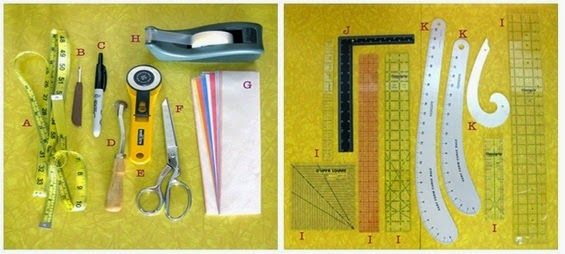
Tools use for Drafting

A: Tape Measure
This is likely something you already have in your stash, because if you have been making clothing you should have been measuring your body along the way! If not, pick up a good quality fiberglass tape measure today so you can start your pattern making off right with correct body measurements.

B: Seam Ripper
Like the tape measure, you probably have a seam ripper. You will use this in patternmaking for taking out your basting stitches when you move from the muslin fitting to the pattern drafting stage.

C: Fine Point Sharpie Marker
Muslin versions are always ugly because they are marked up, but you want to make your markings with a permanent and fine point. I like these push-button fine point sharpie pens as the cap always seems to get lost in my studio! These are quick and easy to use.

D: Tracing Wheel
To take your markings from the muslin stage to the patternmaking stage, this tool will pierce through the paper and leave behind marks to draft with a mechanical pencil.

E: Rotary Cutter
I like using my rotary cutter for the big broad strokes of cutting muslin. Make sure to use a cutting mat beneath your item to protect the cutting surface of the table underneath!

F: Fabric Scissors
Sharp, high-quality scissors are used for all your fabric cutting in sewing and patternmaking. These will shape the muslin down to the proper size after you have cut it big and broad with the rotary cutter.

G: Tracing Paper
I personally do not use this, but many designers like it for leaving marks behind on their muslins. I like a sharpie or tracing wheel, but try these sheets out and perhaps you will love them! Many people do.

H: Scotch Tape
It is inevitable that you will need to tape pattern pieces together and I find that basic Scotch tape is the best for this.

I: Clear Rulers
Having a variety of clear rulers in different shapes and sizes is essential in your kit for patternmaking. I like having a little one for marking in tiny areas, long ones for making marks for pin tucks, side seam lines, and other parts of the patternmaking process that call for something longer than average. I also have a quilting square with diagonal lines for helping square up corners and creating angles.

J: Right Angle
This is also a huge help in creating perfect 90 degree angles on your pattern. These are also available in clear plastic, which most people prefer. I have had this black one since art school and still use it.

K: Curved Rulers
To shape arm holes, hip curves, hems and other lines that are not straight in patternmaking, it is essential that you have a few different curved rulers to get the proper slope in your pattern.
Tools use for Drafting
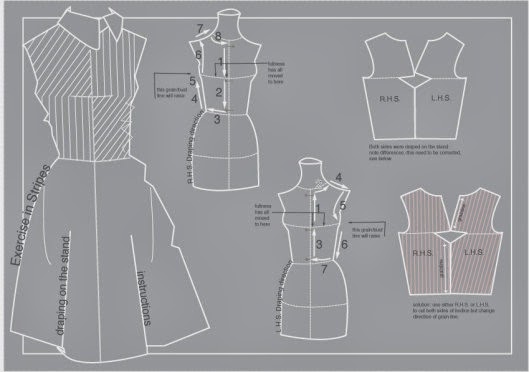
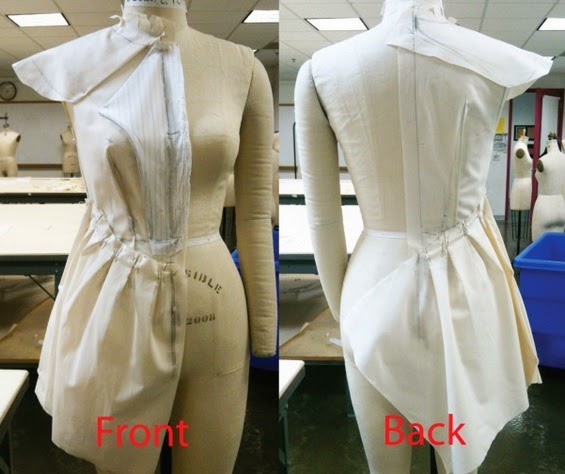
02. Draping: It involves the draping of a two dimensional piece of fabric around a form, conforming to its shape, creating a three-dimensional fabric pattern. Ease allowances for movement are added to make the garment comfortable to wear. Advantage of draping is that the designer can see the overall design effect of the finished garment on the body form before the garment piece is cut and sewn. However, it is more expensive and time consuming than flat pattern making. Draping can be made on a Human body or on a stand.
Add caption

03. Flat Pattern Making: It involves the development of a fitted basic pattern with comfort ease to fit a person or body form. A sloper is the starting point for flat pattern designing. It is a simple pattern that fits the body with just enough ease for movement and comfort. Five basic pattern pieces are used for women’s clothing. They include a snug-fitting bodice front and bodice back with darts and a basic neckline, a sleeve and a fitted skirt front and back with darts. However, as fashion changes frequently women’s styles fluctuate frequently. These basic slopers are then manipulated to create fashions. Nowadays draping is also tested by Computer aid techniques. A basic sloper has no seam allowances, which facilitates its manipulations to various styles. It has no design interest, only construction lines are marked on it. It is necessary that the basic structure of a sloper should be such that adjustments can be introduced easily. For a good pattern making, accurate measurements are of utmost importance.
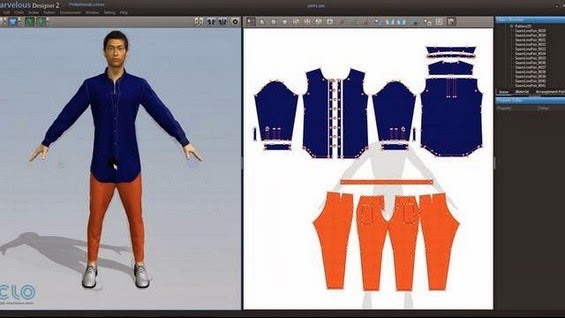
Pattern making by CAD system
The flat pattern making method is widely used in the ready-to-wear market because it is fast and accurate (Aldrich).

Grading: 
 
By following production patterns approved sample is normally made for medium size but if the buyer requires different size then we would have to grade the dimension like S, L, XL, XXL, etc. Grading is an important term in garments manufacturing which means step wise increasing or decreasing the master patterns.
Pattern grading method
For grading the following two techniques are commonly used:
 
Manual Grading: 
The desired range of size is created one by one using pattern templates/master patterns. A first master pattern pieces are sketched on the pattern board and then the points are marked around the pattern pieces as per the direction of grade rules. In this way we can get both the enlarged or reduced size patterns for all sizes of a particular style of garments. A manually operated grading machine can also perform this job. This device grips the master pattern pieces and places on the pattern board as per the predetermined direction after which appropriate edge can be traced out maintaining the grade rule.

Advantages:
  • Cost effective process
Disadvantages:
  • Time consuming process
  • Expected accuracy may not be obtained.
Computer Aided Grading: 
At first grade rules are stored in the computer memory and then the computer can automatically develop pattern sets for all sizes using the direction given in the grade chart.

Advantages:
  • Quick process i.e. less time consumption;
  • High accuracy may be obtained
Disadvantages:
  • High initial cost is involved
  • Skilled operator is required.
Two types of grading are generally done in industry:
  1. Half part grading: If the increasing is done in every sides of a pattern, then it called half part grading.
  2. ¼ th part grading: If the grading acquires increasing or decreasing in any two sides of a pattern, then it is called ¼ th part grading. 


Friday, November 25, 2016

MBA in AMFM

Courses-
01. Design Management Trends in Fashion Industry
02. Product Development and Marketing Strategy
03. Labor Law
04. Business Maths
05. Principles of Accounting
06. Introduction Business of RMG and Textile
07. Intoduction to Pattern and CAD
08. Textile, Dyeing, Printing, Washing and Finishing
09. Operations Management
10. International Business Management
11. Managerial Economics
12. Strategic Brand Management
13. E Commerce
14. International Marketing
15. Internship
16. Financial Management
17. Clothing Material and Cutting Technology
18. Businesses Communication
19. Principles of Management
20. Negotiation and Outsourcing
21. Fully Fashioned Knitwear
22. Cut and Sew Knitwear Technology
23. Apparel Engineering
24. Human Resource Management
25. Practice of Merchandising

Thursday, November 24, 2016

Fair Trade

DEFINITION OF FAIR TRADE

"Fair Trade is a trading partnership, based on dialogue, transparency and respect, that seeks greater equity in international trade. It contributes to sustainable development by offering better trading conditions to, and securing the rights of, marginalized producers and workers – especially in the South.
Fair Trade organisations have a clear commitment to Fair Trade as the principal core of their mission. They, backed by consumers, are engaged actively in supporting producers, awareness raising and in campaigning for changes in the rules and practice of conventional international trade." They can be recognised by the WFTO logo.
Fair Trade is more than just trading:
  • It proves that greater justice in world trade is possible.
  • It highlights the need for change in the rules and practice of conventional trade and shows how a successful business can also put people first.
  • It is a tangible contribution to the fight against poverty, climate change and economic crisis.

WFTO prescribes 10 Principles that Fair Trade Organisations must follow in their day-to-day work and carries out monitoring to ensure these principles are upheld. (The principles are also available in English, Spanish, Chinese, Japanese, RomanianSlovenianHindi and Bulgarian)
Principle One: Creating Opportunities for Economically Disadvantaged Producers
Poverty reduction through trade forms a key part of the organisation's aims. The organisation supports marginalised small producers, whether these are independent family businesses, or grouped in associations or co-operatives. It seeks to enable them to move from income insecurity and poverty to economic self-sufficiency and ownership. The organisation has a plan of action to carry this out.

Principle Two: Transparency and Accountability
The organisation is transparent in its management and commercial relations. It is accountable to all its stakeholders and respects the sensitivity and confidentiality of commercial information supplied. The organisation finds appropriate, participatory ways to involve employees, members and producers in its decision-making processes. It ensures that relevant information is provided to all its trading partners. The communication channels are good and open at all levels of the supply chain.
Principle Three: Fair Trading Practices
The organisation trades with concern for the social, economic and environmental well-being of marginalised small producers and does not maximise profit at their expense. It is responsible and professional in meeting its commitments in a timely manner. Suppliers respect contracts and deliver products on time and to the desired quality and specifications.
Fair Trade buyers, recognising the financial disadvantages producers and suppliers face, ensure orders are paid on receipt of documents and according to the attached guidelines. For Handicraft Fair Trade products, an interest free pre-payment of at least 50 % is made on request. For Food Fair Trade products, pre-payment of at least 50% at a reasonable interest is made if requested. Interest rates that the suppliers pay must not be higher than the buyers’ cost of borrowing from third parties. Charging interest is not required.
Where southern Fair Trade suppliers receive a pre payment from buyers, they ensure that this payment is passed on to the producers or farmers who make or grow their Fair Trade products.
Buyers consult with suppliers before canceling or rejecting orders. Where orders are cancelled through no fault of producers or suppliers, adequate compensation is guaranteed for work already done. Suppliers and producers consult with buyers if there is a problem with delivery, and ensure compensation is provided when delivered quantities and qualities do not match those invoiced.
The organisation maintains long term relationships based on solidarity, trust and mutual respect that contribute to the promotion and growth of Fair Trade. It maintains effective communication with its trading partners. Parties involved in a trading relationship seek to increase the volume of the trade between them and the value and diversity of their product offer as a means of growing Fair Trade for the producers in order to increase their incomes. The organisation works cooperatively with the other Fair Trade Organisations in country and avoids unfair competition. It avoids duplicating the designs of patterns of other organisations without permission.
Fair Trade recognises, promotes and protects the cultural identity and traditional skills of small producers as reflected in their craft designs, food products and other related services.
Principle Four:  Payment of a Fair Price
A fair price is one that has been mutually agreed by all through dialogue and participation, which provides fair pay to the producers and can also be sustained by the market. Where Fair Trade pricing structures exist, these are used as a minimum. Fair pay means provision of socially acceptable remuneration (in the local context) considered by producers themselves to be fair and which takes into account the principle of equal pay for equal work by women and men. Fair Trade marketing and importing organisations support capacity building as required to producers, to enable them to set a fair price.
Principle Five:  Ensuring no Child Labour and Forced Labour
The organisation adheres to the UN Convention on the Rights of the Child, and national / local law on the employment of children. The organisation ensures that there is no forced labour in its workforce and / or members or homeworkers.
Organisations who buy Fair Trade products from producer groups either directly or through intermediaries ensure that no forced labour is used in production and the producer complies with the UN Convention on the Rights of the Child, and national / local law on the employment of children. Any involvement of children in the production of Fair Trade products (including learning a traditional art or craft) is always disclosed and monitored and does not adversely affect the children's well-being, security, educational requirements and need for play.
Principle Six:  Commitment to Non Discrimination, Gender Equity and Women’s Economic Empowerment, and Freedom of Association
The organisation does not discriminate in hiring, remuneration, access to training, promotion, termination or retirement based on race, caste, national origin, religion, disability, gender, sexual orientation, union membership, political affiliation, HIV/Aids status or age.
The organisation has a clear policy and plan to promote gender equality that ensures that women as well as men have the ability to gain access to the resources that they need to be productive and also the ability to influence the wider policy, regulatory, and institutional environment that shapes their livelihoods and lives. Organisational constitutions and by-laws allow for and enable women  to become active members of the organisation in their own right (where it is a membership based organisation),  and to take up leadership positions in the governance structure regardless of women’s status in relation to ownership of assets such as land and property.  Where women are employed within the organisation, even where it is an informal employment situation, they receive equal pay for equal work.  The organisation recognises women’s full employment rights and is committed to ensuring that women receive their full statutory employment benefits. The organisation takes into account the special health and safety needs of pregnant women and breast-feeding mothers.
The organisation respects the right of all employees to form and join trade unions of their choice and to bargain collectively. Where the right to join trade unions and bargain collectively are restricted by law and/or political environment, the organisation will enable means of independent and free association and bargaining for employees. The organisation ensures that representatives of employees are not subject to discrimination in the workplace.
Principle Seven:  Ensuring Good Working Conditions
The organisation provides a safe and healthy working environment for employees and / or members. It complies, at a minimum, with national and local laws and ILO conventions on health and safety.
Working hours and conditions for employees and / or members (and any homeworkers) comply with conditions established by national and local laws and ILO conventions.
Fair Trade Organisations are aware of the health and safety conditions in the producer groups they buy from. They seek, on an ongoing basis, to raise awareness of health and safety issues and improve health and safety practices in producer groups.
Principle Eight:  Providing Capacity Building
The organisation seeks to increase positive developmental impacts for small, marginalised producers through Fair Trade.
The organisation develops the skills and capabilities of its own employees or members. Organisations working directly with small producers develop specific activities to help these producers improve their management skills, production capabilities and access to markets - local / regional / international / Fair Trade and mainstream as appropriate. Organisations which buy Fair Trade products through Fair Trade intermediaries in the South assist these organisations to develop their capacity to support the marginalised producer groups that they work with.
Principle Nine:  Promoting Fair Trade
The organisation raises awareness of the aim of Fair Trade and of the need for greater justice in world trade through Fair Trade. It advocates for the objectives and activities of Fair Trade according to the scope of the organisation. The organisation provides its customers with information about itself, the products it markets, and the producer organisations or members that make or harvest the products. Honest advertising and marketing techniques are always used.
Principle Ten: Respect for the Environment
Organisations which produce Fair Trade products maximise the use of raw materials from sustainably managed sources in their ranges, buying locally when possible. They use production technologies that seek to reduce energy consumption and where possible use renewable energy technologies that minimise greenhouse gas emissions. They seek to minimise the impact of their waste stream on the environment. Fair Trade agricultural commodity producers minimise their environmental impacts, by using organic or low pesticide use production methods wherever possible.
Buyers and importers of Fair Trade products give priority to buying products made from raw materials that originate from sustainably managed sources, and have the least overall impact on the environment.
All organisations use recycled or easily biodegradable materials for packing to the extent possible, and goods are dispatched by sea wherever possible.

Monday, November 14, 2016

Aramid Fibers


Aramid Fibers

Introduction
In the research labs at E. I. Du Pont de Nemours & Company, Inc., in 1965 two research scientists, Stephanie Kwolek and Herbert Blades, were working in a corporate lab to create a new fiber. The technology they developed had enhanced strength, was lightweight and very flexible.  The new fiber, called Kevlar, could be offered in many different forms.  One of the most popular uses of Kevlar came in the form of bullet-resistant vests that police officers have relied on for over 25 years.  The greatest attribute of the fiber was strength it provided in a very lightweight form, that was both comfortable and gave a wide range of movement to the officer.  This discovery came from a very chemically similar compound called Nomex.  The creation of this fiber gave birth to thermal technology, which combined heat and flame resistant properties along with advanced textile characteristics. 
The production of aramid fibers known under their trademark names Kevlar® and Nomex.® have unique and beneficial properties.  These two aramids are similar in basic structure and are sometimes produced in the same production plants.  The difference is in their structure, Kevlar® is a para-aramid while Nomex® is a meta-aramid.    An aramid is a polyamide where at least 85% of the amide bonds are attached to aromatic rings.  The first aramid produced was called Nomex® introduced by Du Pont in 1961.  For this report we will dissect each fiber separately. 

Kevlar®

History
Kevlar® was originally developed in the 1960’s with the chemical name of poly-paraphenylene terephthalamide; but chemists to this day still do not understand why the fiber is so strong.  First introduced commercially by Du Pont in 1972, the fiber has similar competitors in Twaron and Technora.  Kevlar was originally developed as tire chord material for belts and carcasses in radial tires. The common uses for Kevlar® today include:  adhesives and sealants, ballistics and defense, belts and hoses, composites, fiber optic and Electro-mechanical cables, friction products and gaskets, protective apparel, tires, and ropes and cables.  These include items such as trampolines and tennis rackets.

Characteristics
            The resounding characteristic of Kevlar is its remarkable strength.  This very strong fiber has made its biggest impact in the ballistics defense where it’s used in bulletproof vests.  It is stronger than fiberglass and five times stronger than steel on a pound-for-pound comparison.   The high tensile strength and modulus are characteristics of all the Kevlar fibers, with Kevlar 49 and Kevlar 149 showing an even higher modulus.  Kevlar’s chains are ordered in long parallel chains, and the key structural feat is the benzene aromatic ring that has a radial orientation that gives the molecule a symmetric and highly ordered structure that forms rod-like structures with a simple repeating backbone.  This creates an extremely strong structure that has few weak points and flaws.  The table provided below shows the various characteristics of Kevlar fibers and where compiled from both the Chemical Economics Handbook and Encyclopedia of Chemical Technology, Vol. 19.

Properties of Commercial Aramid Fibers


Fiber type
Density, (g/cm3)
%Elongation
Modulus, Gpa
Tenacity
Kevlar 29
1.43
3.6
70
          20-23
Kevlar 49
1.45
2.8
135
          20-26
Kevlar 119
1.44
4.4
55
              N/a
Kevlar 129
1.45
3.3
99
              N/a
Kevlar 149
1.47
1.5
143
18
Nomex
1.38
22
17
5.8

Notice the much higher modulus and lower % elongation from Kevlar 49 and 149.
All of the general features of Kevlar listed here are taken from Du Pont’s web homepage:
·         ·        High Tensile Strength at Low Weight
·         ·        Low Elongation to Break
·         ·        High Modulus (Structural Rigidity)
·         ·        Low Electrical Conductivity
·         ·        High Chemical Resistance
·         ·        Low Thermal Shrinkage
·         ·        High Toughness (Work-To-Break)
·         ·        Excellent Dimensional Stability
·         ·        High Cut Resistance
·         ·        Flame Resistant, Self-Extinguishing
These features give a good picture on why Kevlar is a popular choice for all protection and casing purposes; low conductivity and self-extinguishing, flame resisting characteristics have made it a component for wire casing and fire fighting protection.  The interesting thing is that it has a high elongation at break at around 4%, however it is commonly used in fiber that includes Lycra spandex. 

Chemistry/Manufacture


KEVLAR® is a crystalline molecule that consists of long molecular chains that are highly oriented and show strong intermolecular chain bonding in the para position.  It is made from the reaction of para-phenylenediamine (PPD) and molten terephthaloyl chloride.  The production of p-phenylenediamine is difficult because of the diazotization and coupling of aniline.  The reaction compounds involving the production Kevlar using p-phenylenediamine and terephthaloyl chloride is shown below.                                                        


style='mso-tab-count:2'>                 

The PPD and the terephthaloyl chloride are reacted by using N-methylpyrrolidone as a reaction solvent. The structure for poly-paraphenylene terephthalamide is shown below.


The resulting polymer is filtered, washed and dissolved in concentrated sulfuric acid and is extruded through spinnerets.  It then passes through a narrow duct and goes through the wet spin process where it is coagulated in sulfuric acid.  The filament can take two different paths at this point.  It can be formed into a yarn, washed and dried which is wound into spools that produces a modulus of 400-500 g/denier. Conversely, the filament can go under further heat treatment with tension and produce a fiber with a modulus of 900-1000 g/denier.  The end product can take several forms.  It can form filament yarns, pulp, or spun-laced sheets and papers. 

Economic Impact
The production of fibers like Kevlar is really an oligopoly.  Du Pont, being the producer of Kevlar is the largest producer para-aramids in the world.  Du Pont currently produces in three countries: the United States, Northern Ireland, and Japan.  These three sites have a production capacity of 65.9 million pounds of the 94.7 million pounds of total aramid fibers capacity.  The other producers are Aramid Products in the Netherlands, which makes Twaron and Teijin Ltd of Japan, who makes Technora.  Russia also produces a very low percentage of para-aramids called Fenylene. 

Below is a production table for all para fibers in the last two decades.  As of 1998, Kevlar accounted for 85% of the global market of para-aramid fibers.  Production in Western Europe and Japan has jumped up greatly in the last ten years.  All of the production in the United States is done by Du Pont to produce Kevlar.  Also Du Pont accounts for about one-third of the total production in Europe and about one-half of the production in Japan. 

World Production of Para Fibers (millions of pounds)


United States
Western Europe
Japan
Russia
Total
1979
13
0
0
             <1
13
1986
29
                            <1
0
2
31
1988
29
6
            <1
2
37
1990
29
10
1
3
43
1991
26
10
4
2
42
1992
23
11
7
2
43
1993
23
12
7
2
44
1998
31
16
8
3
58
***Figure from this table taken from the Chemical Economics Handbook
Consumption of para-aramids in the three major regions: United States, Western Europe, and Japan hit 39 million pounds in 1993 and increased to 47 million pounds in 1998. 

The growth of Kevlar has not yet met it’s full potential.  The rapidly growing uses for Kevlar include ballistic protection in Western Europe, truck and bike tires, and with it’s lightweight dielectric properties, tension reinforcement for fiber optic above ground cables and protective coverings for underground and underwater fiber optic cable. Of all the Kevlar imported; 50% is used for tire manufacture, while the rest is used for fiber optics, brake materials, and for industrial fabrics.  Dunlop Tire Corp. has begun to make a tire that is 30% lighter than traditional tires and that eliminates the steel belt and bead wire.  The only catch that’s holding back a full scale use of Kevlar is its price; 1,500 denier is commonly used for tire cord, hoses and belts costs $12.00 per pound, while the other common grades of Kevlar range in the $13.00 to $15.00 range.  Outside of the U.S., the same 1,500 denier fiber costs $23.00-27.00 per pound.  Even with the expanding market as it currently is, widespread growth will not be realized until the costs of production falls.

Nomex®
 
History
NOMEX® was developed by DuPont for in 1961 for products that needed dimensional stability and good heat resistance.  Nomex® products are used in protective apparel, hot gas filtration, and automotive hoses, electrical insulation, aircraft parts, and sporting goods.

Characteristics
The properties of Nomex include great electrical insulation properties at high temperatures.  Nomex does not flow or melt upon heating and doesn’t degrade or char at temperatures until well over 370 degrees Celsius.  The compound that is usually found in fire-fighters coats and airline seat covers is Nomex III, which is a composite of 95% Nomex and 5% Kevlar.  The Kevlar adds stability and tear resistance to the material.  The general properties of Nomex are listed below.
·         ·        Heat and Flame Resistant
·         ·        High Ultraviolet Resistance
·         ·        High Chemical Resistance
·         ·        Low Thermal Shrinkage
·         ·        Formable for Molded Parts
·         ·        Low Elongation to Break
·         ·        Low Electrical Conductivity

This properties cause paper made by Nomex to be stronger and tougher than regular cellulosic papers.  Overall, Nomex® is both thermally and chemically very stable.  The difference between Kevlar and Nomex is the location of the amide linkages on the aromatic ring.  Those differences cause Nomex to a lower modulus and tensile strength and a higher elongation and solubility in organic solvents.
Chemistry/Manufacture
Nomex®, is a meta-aramid fiber created by Du Pont in 1961.  The chemical name of Nomex is poly (m-phenylene isophthalamide), which is produced from the reaction of m-phenylenediamine and isophthaloyl chloride whose structures are shown below.


 The solution is dry spun through spinnerets.  The remaining solvent is evaporated, the filament is washed and wound into tow, heated, and finally stretching into rolls at a temperature of 150 degree’s Celsius.  Nomex can be produced as a continuous filament yarn, staple, spun yarn, floc, pressboard, paper, needle felt, or as a fabric.  Next we will take a look at the economics of producing Nomex.

Economic Impact
The growth of meta-aramid fibers has grown steadily over the last 10 years.   At the same time the U.S. share of production has fallen 19% from 1990 to 1998 from 81% to 62%.  This drop is largely due to the growth of production in Western Europe, from no production in 1990 to 21% of the market share in 1998.  The table below shows production patterns of meta-aramids since 1979.
  
World production of Meta-Aramid fibers (millions of pounds)


United States
Western Europe
Japan
Russia
Total
1979

12
0
           <1
           <1
12
1986

18
0
2
1
21
1988

20
0
2
2
24
1990

21
0
4
2
26
1991

23
0
4
1
28
1992

24
0
4
        neg
28
1993

26
2
4
        neg
32
1998

26
9
5
2
42
***Figures taken from the Chemical Economics Handbook

The world production has more than tripled in the last three decades while consumption in the U.S. only grew 60%.  This is due the great increase of consumption in Western Europe and growth in Japan.  The uses of this consumption is largely for the production of paper electrical uses, as insulators in dry transformers, motors, and transformers which account for 49% of all U.S. consumption.  In the textile industry, fire resistant fabric accounts for 19% and filtration 17% of all U.S. consumption.  Overall, the expected annual growth rate for meta-aramids is suppose to average 3% a year until 2003.  The textile industry is responsible for the production of fire-resistant clothing and seat covering in airline seats.  It also has established a market in asbestos replacement, thermal insulation and as a fiber that prevent static electricity buildup.  The prices for meta-aramid fibers range greatly. The staple 1.5-denier fiber cost $11.50 per pound while continuous filament yarn of 200 denier cost $25.00 per pound.  Even more, 1,200 denier filament yarn costs 39.00 per pound!
Summary
          In this paper, I have dissected the chemistry and the growing markets of the specialty fibers Kevlar and Nomex.  Each of these fibers has shown extensive growth over the last few decades with growth expected to continue over the next several years.  This poses the question on whether we should expand into these markets and capitalize on this growth or sit by the wayside.  In my opinion, the outlook for polyamids such as Kevlar and Nomex aramids is very good.  Du Pont, an established company whose products are well known and trusted, dominates the production of these fibers.  Over the next several years, Du Pont is going to profit from the production of these fibers.  With the established name brand and quality that Du Pont already holds, the barriers to enter the market are too great for any company to start up and take their strangle hold over the aramid market.  The invention of these fibers grew from the research from making very basic items into one of the most structurally sound products made today.